I fell in love with the City immediately, and managed to squeeze in a few things other than museums. Well, one extra museum too! I had a fairly quick visit to the Hermitage and the exhibition of jewelry of the Czars. It included jewelry, treasures, clothing and portraits of women wearing the jewelry, including a portrait of Catherine the Great in her later years. The jewely with what appears to be cameos are actually exquisite papier-mache. I want the purple dress (and the waistline)!
Jewels!
Bicycles!
I must have seen a million bicycles, all ages ride them. Brilliant! Even a packed bicycle parkade.
Canal Ride
I would say a boat ride on Amsterdam’s canals is the quintessential experience, but others might think the red light district, beer culture or pot cafes are quintessential. There is something for everyone!
The shopping is great, too.
I lucked out with the weather, making this a good time to come, still lots of tourists around but not as crowded at the main sites as it would be other times of year. The weather was predicted to be part sun, part cloud, but the sun was kind of like the vermouth in my Dad’s martini, just a spritz of the thinnest possible sun – but I didn’t get caught in any rain, either. I could come here over and over and still have more to see – I think it’s the Barcelona of the north!
One of the world’s great art museums, the Rijksmuseum was built in 1885. It closed for massive restoration from 2003 to 2013. The massive entryway is now saturated with light.
Still Life
I remember being floored at the Louvres’ collection of Dutch still life.The paintings, reflect the wealth and power in Amsterdam In the 17th century.They also sometimes contained subterfuge, showing the contrast between the wealthy and the needy.They often honoured nature and represented scientific accuracy in some of the most beautiful paintings ever painted.The still life rose in popularity, expressing both objects of beauty and the philosophical climate of the times through carefully composed arrangements and groupings.
Breakfast with Crab, Willem Claeszoon Heda
The still life in the Netherlands in this period became a source of competition for artists and their patrons and inevitably, several subcategories emerged.An ‘ontbijtje’, or small breakfast, became a particular genre as were flower pieces, banquets, paintings featuring the results of the hunt, and Vanitas paintings. The Vanitas were paintings that reminded the rich burghers of the Netherlands that everything – including their wealth – was transient.The peeled lemon here symbolises deceptive appearance: beautiful on the outside, sour within. Beware the beautiful looking man or woman, they may not be as sweet as they appear. There was a tension that developed in this period between the new Protestant religion that devalued objects of wealth that had previously been used to display the power of the Catholic church and therising nouveau riches who commissioned paintings that demonstrated their ostentation.
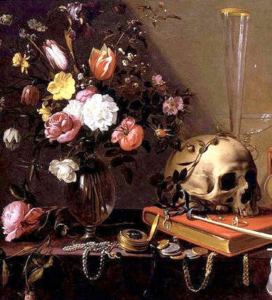
Still Life with Bouquet and Skull, Adriaen van Utrecht
Some versions of the Vanitas are less opaque, like this one at the Rijksmuseum, Still Life with Bouquet and Skull, Adriaen van Utrecht
A couple more stood out in my visit today – Pieter Claesz’ Still Life with a Turkey Pie – complete with turkey:
And de Heem’s Festoon of Fruit and Flowers:
Rembrandt (1606-1669)
“I can’t paint the way they want me to paint and they know that too. Of course you will say
that I ought to be practical and ought to try
and paint the way they want me to paint.
Well, I will tell you a secret.
I have tried and I have tried very hard,
but I can’t do it. I just can’t do it!
And that is why I am just a little crazy.”
– Rembrandt
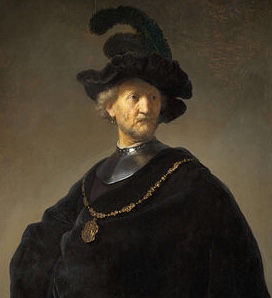
Old Man with a Gold Chain
During the Dutch Golden Age, portraiture rose in popularity.Members of the new merchant class enjoyed commissioning imaginative likenesses of their selves to display in their homes, and companies and other professional organizations would also acquire group portraits. Rembrandt was one of the greatest portraitists of this time, known for his impeccable capturing of his subjects’ distinct personalities and emotional idiosyncrasies.
The Original Selfie
When Rembrandt wasn’t being paid to paint other people’s portraits, he used himself as a study.His extensive self-portraits provide a unique visual biography of the artist.It would be a mistake to assume the vanity that exhibits itself in today’s selfies; Rembrant’s self-portraits are candid, vulnerable and inward-gazing.
Selfportrait when young *oil on panel *22.6 × 18.7 cm *
Rembrandt wasn’t the only painter who made self-portraits.
“I paint self-portraits because I am so often alone, because I am the person I know best. ”
– Van Gogh
Frida Kahlo, the artist from Mexico whom we’ll be seeing much more of next spring, used her self-portraits to express fundamental truths: what it was to be a woman, what it was to be Mexican, what it was to be an individual and lastly, what it was to be her.
Etchings
Rembrandt also made important contributions to the development of art, surpassing even the inventiveness of Titian and Velazquez with his progressive handling of paint, making it as much a subject in the composition of a painting as his figures. Variations of brush stroke between loose and rough, or the manipulation of textures through scratching or with a palette knife, would all contribute greatly to a radically new signature style that would influence generations to come.He also raised the etching process to an art form and arguably remains the greatest of all at creating etchings.
The Night Watch
“Rembrandt goes so deep into the mysterious that he says things for which there are no words
in any language. It is with justice that they call
Rembrandt ‘magician’ – that’s no easy occupation.”
– Van Gogh
Rembrandt’s monumental masterpiece The Night Watch is considered by many to be the pinnacle of Golden Age Dutch painting. Formally titled “Militia Company of District II under the Command of Captain Frans Banninck Cocq” the dramatically rendered military group portrait has an epic history all its own.Rembrandt’s innovative decision to depict the military in a moment of action rather than a traditional composed group portrait, as well as the work’s nearly life-sized scale made the painting a triumph of 17th Century Dutch art.At the time he made it, Rembrandt was at the height of his creative powers.The subtle use of texture, shadow and light seem to reveal truths about his subjects that they may be unaware of themselves. His greatest influence was Caravaggio, who took darkness and light to extreme.
David with the Head of Goliath, Caravaggio
Franz Hal’s The Meagre Company is a more typical posed Guard portrait of the day:
The Night Watch fame has only been heightened by its storied and indeed dramatic history. The painting has been subject to attack on three separate occasions — the last, an attack by knife, leaving the painting in need of extensive restoration.It is under restoration now, too, but the museum has drawn the public into the process by keeping the piece on view with high-tech equipment and restorers working on the painting in plain sight. The restoration work can be followed around the world online live each day in a project called “Operation Night Watch,” here.
Each portrait is a masterpiece within it – here are a few:
Vermeer (1632-1675)
Until more recently, so little was known about Vermeer’s life, he was referred to as “The Sphinx of Delft.”Well-known and moderately successful within Delft, he never left the city and was devoted exclusively to his art.
Vermeer specialized in scenes of domestic bliss, the type of bliss which evaded him in his own life.He worked slowly and with great care, which is why he was not prolific, having painted about 50 known paintings (compare that to van Gogh’s output!), of which only 34 survive.There is no other 17th-century artist who employed the exorbitantly expensive pigment lapis lazuli (natural ultramarine) either so lavishly or so early in his career and this later would perhaps contribute to his financial ruin.
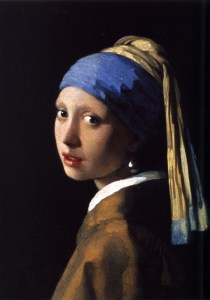
He is particularly renowned for his masterly treatment and use of light in his work, for example, the glint, in the eyes and pearl of the Girl with the Pearl Earring (at The Hague Museum), the appearance of wetness to her eyes and mouth, and the warm light captured in his Dutch interiors, so much so, that he became known as “the Master of Light.”His primary influence was Leonardo da Vinci.
The Milkmaid
In Dutch literature and paintings of Vermeer’s time, maids were often depicted as subjects of male desire—dangerous women threatening the honor and security of the home, the center of Dutch life—Vermeer’s painting is one of the rare examples of a maid treated in an empathetic and dignified way, although established amorous symbols in this work, like the Cupid tile and the foot warmer on the floor, still exemplify the tradition.
Vermeer certainly meant for the sophisticated viewer to recall earlier paintings of comely milkmaids and kitchen maids, and the reputation of milkmaids in particular for sexual availability. In real life, their impromptu suitors were often “proper” gentlemen, not social equals, and of course the intended viewer of this painting (and those by Dou) was not a servant but a man of society and a connoisseur. Compared with the sort of ideal women we see in Young Woman with a Water Pitcher and other mature works by Vermeer, his “Milkmaid” exudes a very earthy appeal, with her pushed-up sleeves (revealing pale skin normally covered), her ample form (similar to that of women in slightly earlier works by Rubens), and her faint smile. For a male viewer of the time (in this case, Vermeer’s patron Pieter van Ruijven), the hints of sexuality would have given the painting an element of fantasy as subtle as the shadows on the whitewashed walls.
The painting has much more depth and richness seeing it first-hand, but here are my impressions of it:
Eventually Vermeer’s lack of productivity and extravant spending forced him into bankruptcy and he was barely able to support his wife and seven children.In December 1675, at age 42, Vermeer died after a short illness. In a petition to her creditors, his wife later described his death as follows:
“…during the ruinous war with France he not only was unable to sell any of his art but also, to his great detriment, was left sitting
with the paintings of other masters that he was dealing in. As a
result and owing to the great burden of his children having no
means of his own, he lapsed into such decay and decadence,
which he had so taken to heart that, as if he had fallen into
a frenzy, in a day and a half he went from being healthy
to being dead.”
I found at the following link a compelling video, a debate about who is the greater artist, Rembrandt or Vermeer, between the charismatic art critic and BBC favourite, Simon Schama, and the author of the novel which became the Scarlett Johannsen film, Girl with a Pearl Earring, Tracy Chevalier.In reality, one doesn’t have to choose, but their insights into both artists are fascinating.
Serendipitously, my brief stopover in Amsterdam which led me to the Dutch Golden Age, was en route to the City of Cape Town, the founding city of South Africa. Cape Town was originally a Dutch outpost of the Dutch Golden Age, when Dutch settlers were sent to grow fresh fruits and vegetables for the ships of the Dutch East India Company on their trade route. I’m headed there next, on a 12-hour KLM flight.
Best,
Jan
PS Rembrandt was born Rembrant Harmenszoon van Rijn in 1606.He added the silent ‘d’ to his signature for reasons unknown, in 1633.
Florence had the Renaissance, Vienna had its Classical Period, Paris had its Belle Epoch and the salons of the 1920’s, and New York was a hotbed of modern art in the World War II and post-war period. Amsterdam in the 17th century was one of those cities that experienced a moment in time, attracting artists who inspired and influenced one another, creating new and original art forms.
Simon Jacobszoon de Vlieger, The Flagship Aemilia Fires a Salute for Admiral Maerten Harpertszoon Tromp
The movement that sprang up in Amsterdam arose from the economic success borne of the 80 Years’ War.Strategically located, the nation controlled access to the Baltic Sea and charged hefty duty to foreign ships passing through.They established their own marine silk trade routes. The Dutch nation became one of the wealthiest and most powerful in the world, dominating international trade and creating a vast colonial empire. Tne upper middle class surged in the strong economy and it was at this time the Dutch built their world-famous canal system, so impressing Russian Czar Peter I that he patterned his new capital, St. Petersburg, after it.You see it as soon as you arrive in “Peter” – canals (which absorbed the wet lowlands) down the centre of lovely mansion-lined streets.
Still Life with Flowers, Willem van Aelst, 1665
With all the new-found money and painters arriving in Amsterdam, it was little wonder the Dutch Golden Age of painting was just around the corner.
The Netherlands’ religion changed too, and this had a powerful effect on the art world.The Netherlands declared independence from the Catholic Hapsburg Empire and the protestant religion took its place. With the end of Catholicism, a new and unprecedented freedom replaced the genre of religious art with several different styles.Landscapes, portraiture, “genre painting” (simple domestic bliss), and still life blossomed.Some of the most famous artists of all time painted during the Dutch Golden Age, including Rembrandt and Vermeer.
Still Life with Dog, Monkey and Parrot, Adriaen van Utrecht
My day was so packed today, I’m posting in two parts. The Dutch state museum, the Rijksmuseum houses Rembrandt’s most famous painting known as The Night Watch.I spent much of the day at the Rijk, taking a guided tour. And, although much later in history, one cannot overlook perhaps Amsterdam’s most famous citizen, Vincent van Gogh.I visited the Van Gogh Museum first, the largest collection of his work in the world, housing some of his most famous and important paintings.
Van Gogh (1853-1890)
“Real painters do not paint things as they are… they paint them as they themselves feel them to be.“
– Vincent van Gogh
What more needs to be said about the iconic tortured artist, Vincent Van Gogh?I’ve seen “Starry Night” at MOMA which is so representative of his luscious, flowing, late work, but since my teens reading the book, Lust for Life, by Irving Stone (one of my favourite reads of all time), I have wanted to go to Amsterdam to see his early work, The Potato Eaters. He was in a state of fervent activity, young, poor, but compelled to reproduce everything he saw, producing many sketches per day. The farm labourers in the Netherlands, achingly depicted in the resulting painting, were almost caricatures. He expressed in this painting the connection of the poor peasants to the land, their work-weary hands central to the picture. But when he sent the work to his brother Theo, the art dealer said, no, you have to come to Paris and see what Monet, Gaugin and the others are doing with colour and light, you need to start again! In the end, it was not long in Paris before his fellow painters influenced him and he started using colour and light in new ways too. I still love this one, though, the faces tell the whole story of the people.
In addition to seeing his paintings, some of the best ways to capture how van Gogh strove to convey his emotional and spiritual state in each of his paintings came in recent films. The visually beautiful animated film Loving Vincent (on Netflix)
“His post-Impressionist style, canvases with densely laden, visible brushstrokes rendered in a bright, opulent palette
emphasize Van Gogh’s personal expression brought to life
in paint. Each painting provides a direct sense of how the
artist viewed each scene, interpreted through his eyes,
mind, and heart, just as he intended. This radically
idiosyncratic, emotionally evocative style has continued
to affect artists and movements throughout the 20th
century and up to the present day, guaranteeing Van Gogh’s
importance far into the future.”
It’s amazing to be reminded that van Gogh only painted for about seven years, and in that time he created about 2,100 artworks, including around 860 oil paintings, most of which date from the last two years of his life. The gallery also houses one of his five Sunflower paintings, his Vase with Irises and his Bedroom at Arles, to name a few.
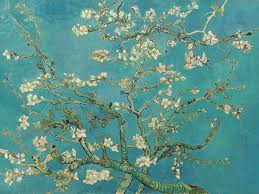
No photography is permitted here, but here is an image of his Almond Blossom – you can see his love of Japanese art here. He painted this as a gift for his brother and sister-in-law on the arrival of their first child. The couple named him Vincent after his uncle.
Vincent – the nephew – eventually inherited the van Gogh estate from his mother and he almost immediately began negotiations with the Dutch government to subsidise a foundation to purchase and house the entire collection. He participated in planning the project in the hope that the works would be exhibited under the best possible conditions. The project began in 1963; architect Gerrit Rietveld was commissioned to design it, and after the architect’s death in 1964, Kisho Kurokawa took charge. Work progressed throughout the 1960s, with 1972 as the target for its grand opening.
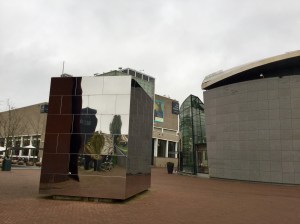
The Van Gogh Museum opened in the Museumplein in Amsterdam in 1973. It quickly became the second most popular museum in the Netherlands, after the Rijksmuseum, regularly receiving more than 1.5 million visitors a year.








 Carpe diem