Think Pink!

Solitaire

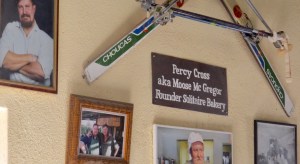
Solitaire, as its name suggests, is one of those out of the way places that never wanted to be popular.  Nothing more than four corners in the middle of the desert at the junction of C14 and C19, the major roads in the Namib-Naukluft National Park, it has a gas station, a general store and, perhaps most importantly, the only tire repair shop between Windhoek and Walvis Bay.  That Percy Cross, a burly Scot looking for tranquility, decided to stop here, bake apple pie and rename himself “Moose McGregor” seems highly improbable, but that’s exactly what he did.

95199D76-6A4C-4573-B7AC-459031227D34

And he made the best apple pie you’ve ever tasted, still served straight out of the oven.

Moose’s tranquility went out the window, but as one of the beloved characters of this land, we think he wasn’t disappointed.  Solitaire, too, belies its true identity – nothing like the reclusive, disinterested place one might assume from its name, it has become the best kind of neighbour.   The two farms that make up Solitaire, the businesses, and other area land holdings, are now part of the 45,000-acre Solitaire Land Trust, focussing on habitat preservation and conservation for the area’s wildlife.  Solitaire’s own fame has grown since it became the focus of the eponymous Dutch novel about author Ton van der Lee’s stay here.  Sadly, Percy Cross died in 2014 at the age of 58.  Solitaire is a diamond in the rough, and we think Percy was too.

0F0D7717-09F7-47A9-8AF3-9672A80F130F

Revivified after our pie and fuel tank refilled, we crossed the canyon of the Kuiseb River right on the Tropic of Capricorn to make our way to Moon Valley.

Since I am a Capricorn, I was interested.

Tropic of Capricorn

6E0B0F31-94ED-4AA4-AA39-1DFCC635423D

73295C57-1D67-4F11-9CF5-9706DF9C8896

The Tropic of Capricorn is the dividing line between the Southern Temperate Zone to the south and the tropics to the north. It is the southernmost latitude where the sun can be seen directly overhead.  (The Northern Hemisphere equivalent of the Tropic of Capricorn is the Tropic of Cancer).   When this line of latitude was named in the last centuries BCE, the Sun was in the constellation Capricornus (Latin for goat horn) at the December solstice, the time each year that the Sun reaches its zenith at this latitude. The word “tropic” itself comes from the Greek “trope (τροπή)”, meaning to turn or change direction, referring to the fact that the Sun appears to “turn back” at the solstices.   

5E99F70F-D4A1-48FE-9727-4DD307774FC0

The line’s position is not fixed, but constantly changes because of a slight wobble in the Earth’s longitudinal alignment relative to its orbit around the Sun.  The line also crosses the Andes in Argentina and Chile.

Moon Valley

9205A217-B06F-4A43-8BC5-7369362CD121


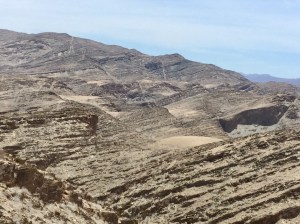
We drove through what was once a mountain range.  Erosion has reduced the Moon Valley to rolling, low-lying hills, and a lunar-like landscape of a thousand colours.  For the past two million years, the Swakop River and its many tributaries flowed through this valley, giving it life and shape.

24561367-B6CA-444E-8393-3CD246F036B0

The landscape had become so harsh it seemed it could no longer sustain life.  There was the beauty of the vast, open sky, but after passing through Moon Valley, the harsh environment seemed to carry on forever.

50FDAC32-352F-46C5-B25E-1653A502CFF6
But as we neared the coast, a line of mist appeared on the horizon and a covering of mossy green lichens coated the sand.  Unique in the world, there are over 100 types of lichen in this desert.  This area is also the source for those tiny air plants that are sold everywhere – plants that don’t attach themselves to anything and require only a misting of moisture for water.

We finally arrived at the coast and pulled into the former British colonial naval port town of Walvis Bay.  We drove toward the lagoon, where I began watching hopefully for pink.

Flamingo
Status:  Vulnerable

3BB820A3-ED9F-4C42-BFBB-171DDB0CB42F

We passed by a massive sea salt production facility and began to understand that this was why flamingos were here, and we got answers to a few other questions, too.   The algae and crustaceans they eat thrive in high saline or alkaline conditions.  According to Curiosity.com, flamingos make themselves at home on some of the most toxic, caustic bodies of water in the world. The water they prefer is often flesh-strippingly alkaline, and the ground that surrounds the shores absorbs those harmful properties. The scaly skin on their legs is tough enough to handle it, but their softer flesh is a little more at risk.  That’s why they sleep standing up.

Speaking of standing up, two scientists actually did an experiment with (already) dead flamingos and found that the joints in flamingos’ legs lock, allowing them to stand securely on one leg without losing their balance or using their muscles to stand.  Even dead, they remain standing when one leg is in the locked position.

Lesser and greater flamingos flock in large numbers to pools along the Namib Desert coast, particularly around Walvis Bay. They’re excellent fliers, and have been known to migrate up to 500 km overnight in search of proliferations of algae and crustaceans.  We must have seen over a thousand of them, along with a handful of pelicans and some plovers.  There were lots of colourful jellyfish here, too.

The greater and lesser flamingos are best distinguished by their colouration. Greater flamingos are white to light pink, and their beaks are whitish with a black tip. Lesser flamingos are a deeper pink – often reddish – colour, with dark-red beaks. Flamingo feeding is endearing, if not somewhat comical, worthy of two very short YT videos.

After a walk on the promenade along the mansion-lined lagoon, we continued on for a short drive on paved road to the former German colonial town of Swakopmund for two nights.

Best,

Jan


The Dead End Marsh

Tuesday we left civilization and drove southwest through the Remshoogte Pass in the mountainous Khomas Hochland (Highlands) to Namib-Naukluft National Park, the 3rd largest national park in Africa. The Namib Desert is a vast wilderness, harsh, primeval, almost uninhabitable – and the oldest desert on earth.   When we get close to the Atlantic coast, we will see some of the tallest sand dunes in the world.   We are spending two nights in this area.

We passed through an ever-changing landscape —

— until we went over a rise and saw below us the dreamy scene of the Namib Desert spread like a banquet of colours below us.

I wasn’t sure if we would see any animals today, but we were rewarded at every turn.   The most interesting architecture we encountered were the nests of the Social Weaver Birds.  They build their nests together with each bird having a private entrance.  When the nest becomes so heavy it is at risk of collapsing, they divide it.  Another interesting behaviour is that they will drag a wasps’ nest onto their tree.  The wasps don’t bother them, but if their main predator snake arrives to eat the eggs or the young, the wasps attack and kill it.  How did they work this out?  Ingenious!

Here is a complete list of what we saw on our first day into the Namibian countryside:  ostriches, wart hogs, baboons, oryx, a lappett-faced vulture, kudus, 2 springbok herds, termite mounds, steenbok, cardinal woodpeckers, and most exciting were a herd of Hartmann’s Mountain Zebra, including a young colt.  Apologies for the poor quality of some of these but I’m including them for posterity.  Pictured (in order) are:  Springbok, kudus, steenbok, woodpeckers, Oryx and zebras.

Sossusvlei

Today, Wednesday, we got an early start – 5:15 a.m.  – and we were so glad we did – the sun and the moon were both out at the same time.

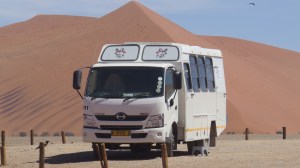
We started at Sossusvlei, the “Dead-End Marsh,”  a salt-clay pan depression with dunes that come together preventing the Tsauchab River to flow any further some 60 kms east of the Atlantic Ocean.  We transferred from our cool bus/truck –

4EA49D52-AC10-4CFF-A0B9-E489C8D6C8B3

– to a 4×4:

B7A03CBB-644C-4C0A-9E87-E57D2C517F7D

and drove about 4 kms and then walked 1.2 km to the basin.  A photographer’s dream,  the contrast in colours and the graphic dead trees seem a metaphor for the near-lifelessness of the desert and the transience of life itself.

We saw lots of Oryx this morning, and we stopped to see the plant that keeps Oryx alive.  They don’t drink water at all, but are able to extract moisture from the plants they graze.  Their primary source, however, are from the melons which incredibly grow in this hostile environment on the N//ala plant (that is Nala with a click in there).  Tuhafeni picked a used-up dried sample – for the sake of the Oryx, he of course wouldn’t pick a living version.

The sand dunes here are the largest in the world and looked as if they had been painted by brush rather than by wind.


BAD06BB7-3957-4E56-BDDB-173F9916AD70

The ever-shifting sands can overwhelm human attempts at order.

2BA2DC7A-7224-4F4A-8F2D-060801F9F76B

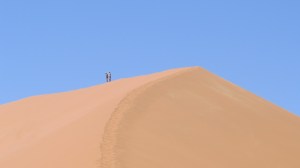
Two of our adventurers made it to the top of the renowned dune, “No. 45.”

We saw a number of pretty birds, including a Pied Crow and a Kestrel, and the tracks of a jackal:

Six Rawhide Thongs

This afternoon we visited the stunning Sesriem Canyon, carved by the Tsauchab River in the local sedimentary rock, about a kilometre long and up to 30 meters deep. The name Sesriem in Afrikaans means “six rawhide thongs,” given by settlers who had to join six such thongs in order for a bucket to reach the water. Sesriem Canyon is only two metres wide in some places, and usually has a portion that contains water, but we didn’t see any.

We saw lots of animals today but the most thrilling ones I saw were the ones seen right from my room of our delightful lodge, the Desert Homestead. including a juvenile Oryx, a half-hidden baby in the crowd and an ostrich cooling itself down.  It doesn’t sweat, but it opens its mouth wide like the panting of a dog, and opens its wings to the breeze.

The setting of this lodge is spectacular and it will be hard to leave it behind.

After a delicious steak dinner, we got the last minute details of our road trip tomorrow.  We will head through Moon Valley, stop at Walvis Bay and reach our final destination, Swakopmund, a former German settlement town on the Atlantic shore.

Best,

Jan

The Forbidden Area


Origins

39910ACC-464B-4D13-9E1C-7E1B7683C05B

Since their arrival in the late 1800’s, German colonials heard rumours about diamonds in Namibia, but none had been found.  One day in 1907 in southwest Namibia, a German railway worker, August Sauch, had one of his men bring him a brilliant, shining stone, clear as ice.  Once the rock was confirmed to be a diamond, Sauch resigned from the railway and began a focussed search for diamonds.  So the mad, richly rewarded hunt for diamonds in Namibia was on.

AEF5A440-B884-4264-848D-0ED90A572188
As far as geologists can determine, beginning sometime during the Jurassic Age, the diamonds that wash up in Namibia were pushed to the surface by Kimberlite Pipes about 800 kilometers to the east, along what’s now the Orange River.  (View of Orange River from my flight to Windhoek below.)

09ED778F-E324-4D0E-B47B-098B664BF12A

The biggest, heaviest diamonds were gradually pulled down river by currents and then eventually into the sea in Namibian coastal waters. The tides are now slowly pushing them back onto land.

621663DD-F1AF-42A8-9B97-709E7524556B
This radar image from the Jet Propulsion Lab at Cal Tech shows Namibia diamond deposits.  It covers a portion of the Richtersveld National Park and Orange River (top of image) in the Northern Cape Province of the Republic of South Africa. The Orange River marks the boundary between South Africa to the south and Namibia to the north.

No Blood Diamonds

Namibia has seen little of the vicious feuds for “blood diamonds” in other African countries.  That’s largely because Namibia’s prized diamonds literally wash up to shore like seashells and would be a beachcomber’s delight if access to prized areas such as the Sperrgebiet (The Forbidden Area), in the Namib Desert were not controlled.

Control

03E2CF77-0D32-4FA8-BF49-0897DF3DA924

The Forbidden Area stretches from the Atlantic to about 100 km inland and covers an area of 26,000 square km.   The German colonial government closed the area and handed the mining rights to Deutsche Diamantengesellschaft (German Diamond Company), who mined over 7 million carats of diamonds.  Cecil Rhodes, a Brit whose family sent him to South Africa due to his ill health, and who would go on to become Prime Minister of South Africa and a great proponent of British imperialism, founded de Beers in 1888 and over the next two decades gained near-complete domination of the world diamond market. After WWI, when Germany was forced out of Namibia, DD sold its interests to De Beers, which went on to mine roughly 65 million high quality carats until Namibia’s independence in 1990.

Rich Quality

Namibia’s diamonds are among the world’s largest and most beautiful gems.  Millions of years of sea currents gradually polish these raw stones to a state of unusual clarity and brilliance. “Namibia’s diamonds fetch the highest prices because they are of high quality, pure carbon, spotless and they don’t disintegrate,” said the country’s Diamonds Commissioner Kennedy Hamutenya, according to Bloomberg.

Namibia Takes (Partial) Control

Namibian independence markedly altered the bargaining power and interests of both Namibia and De Beers.  Independence gave Namibia the power to enact legislation and economic structures to limit and guide its domestic diamond industry.  Following independence, the government needed De Boors for its technology, investments and access to international markets to provide the state with export revenues and provide Namibians with salaries.

At the same time, changes in the international diamond world, particularly the growing challenge from Russia and international pressure to stop the De Beers’ monopoly on the market, weakened De Beer’s bargaining power.  In the 1994 Namibia-De Beers Agreement, Namibia purchased a 50% interest in Namibia’s diamond mining industry and created jobs for Namibian workers.

Namibia Manufacturing

De Beers helped the country set up local diamond manufacturing operations. In 2007, De Beers and Namibia formed another joint venture, Namibia DTC. NDTC supplies diamonds to local companies for local manufacturing.  Over the years, diamond manufacturers repeatedly reported losses until they were authorized to export rough diamonds unsuitable for local polishing to other countries, such as India and China. Today, NDTC supplies 11 manufacturers with rough diamonds in Namibia.

Raw Namibian diamonds sell for around $1,000 a carat, at least triple the price of the high-quality stones mined in Botswana, and well over 10 times the price of most other rough diamonds.

Digging Deeper

Now, the partnership is moving its sights offshore.   There is a vast store of diamonds on the seabed just off Namibia’s west coast.   Almost 10% of Namibia’s economy, estimated at $2.5 billion, comes from the Namibian government’s share of the money collected from selling sea diamonds.

7524C176-821E-40B2-8BD2-835C28AD7E3D

De Beers’ just-announced submarine expansion came in the form of the SS Nujoma, a 2.3 billion Namibian dollar ($166 million U.S.) custom-built exploration and sampling ship, which arrived in Cape Town from Norway in August. De Beers says the ship will almost double the number of seafloor samples unearthed daily.  De Beers claims there is no damage to the environment because everything goes back into the sea except the diamonds, but there is little research to date about how this scale of sea floor intrusion affects marine life.

Just as valued as back in 1907 when the first diamond was discovered and The Forbidden Area established, security on the new ship will be tight.  Within its recovery room, diamonds and other gems will fall into X-ray machines like coins into a vending machine.  Cameras are everywhere and vetted employees will pass through card and fingerprint readers to gain entry.  The diamonds will then be poured into what is a container and sealed, then placed in a vault. A helicopter will come a few times a week to fly the diamonds to Windhoek, Namibia’s capital, for sorting.  Employees leaving the facility will be subject to “rigourous scrutiny” (manual body searches and x-rays).

Namibia Economy

46C49542-4422-41A0-B47B-927A78B46C9E

With over $1 billion worth of annual diamond production, Namibia is the world’s sixth largest diamond miner by value, according to Kimberley Process 2014 figures of $1.92 million in rough production of 1.92 million carats and $1.16 billion; and $1.11 billion in rough exports of 1.97 million carats.   De Beers is still picking diamonds from the coast and from the sea at a rate of more than a million carats every year.  Though the resource is finite and land sources are nearly depleted, De Boors’ subsidiary, Debmarine, estimates at least 62 million carats of diamonds still lie on ocean’s shore.

🇨🇦 Canadian Connection

De Beers is involved in Canada’s diamond mining industry too.  It started by hauling 45-gallon drums of rock samples for transport to South Africa.   Canada became the third largest producer of diamonds, but its run is already nearly deplete.  De Beers has flooded one of its huge Canadian mines; the other, Gahcho Kue, took 21 years to reach production and is now turning out stones worth far less of poorer quality than it hoped.

Benefits to Namibia

With the new technology and its rich diamond resource, Namibia’s diamond industry is thriving for now.  Beyond searching out opportunities in downstream business, the government is also trying to use its diamond resource as a means of achieving social equity through creating racially balanced employment and creating employment based on revenues from the industry.

C1C94042-276A-4ABE-AE73-3BA42A5AD449

NamDeb is a prominent philanthropist in Namibia and is proud of the number of Namibians that work in the company, from the managing director on down.  With a work force of 1,800, it is now focussed on attracting women to this traditionally male industry.  Part of the joint venture’s mission is to make a lasting contribution to Namibia.  It will fall to the government of Namibia to do its planning for the future day when this beautiful, precious resource does run out.

Best,

Jan


Windhoek (pronunciation: ˈvəntɦuk)

   SUUM CUIQUE (“To every man his own”)
Windhoek’s motto

Namibia is a vast country with a relatively small population of about 2.5 million.  Its capital, Windhoek, will be our portal and launch pad.

This cosmopolitan city of 322,000, has six groups of indigenous people as well as remaining Germans and Afrikaaners.  German is widely spoken – there is a German-language daily newspaper, and English is the official language of the Namibian government.  Afrikaans is also widely spoken.  The original buildings from the German occupation are now museums and government buildings.  There is German cuisine and a beer named after the city brewed in strict compliance with the Reinheitsegebot, the German Purity Law of 1516.

The lovely pre-colonial African people are:

  1. The San, whose genetic history has been traced to 70,000 years ago, and who shocked us in the 1980 films with the possibility of a simple beautiful life and the insanity of commercialism in the gentle “The Gods Must be Crazy” series.  They still largely live a traditional nomadic life.   In a few days, we’ll see their fabulous rock art which also dates back 70,000 years.


2.  The Ovambo, who fought for an independent Namibia.   The founding President of Namibia was Ovambo and the SWAPO ruling party today is made up mostly of Ovambo people.4E67F3EB-CB10-413C-B215-343B09A96890

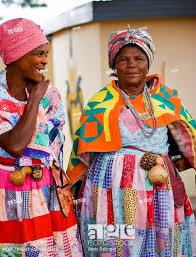
3. 772B19CA-FBA6-4391-9DE9-0230D926B1BFThe Nama, who also wear incredible bright clothes.  The Nama twice rose up in armed rebellion against German colonial rule, and suffered near extermination in what followed the second skirmish.


79FC5C07-08B1-49BD-A796-193B5D9B42434. The Damara, who have the beautiful clicking language.  Today they are pastoralists, and skilled copper-smiths. The first prime minister of Namibia and his immediate successor were both Damara.

5.  The Himba, with their powerful architectural hairstyles, who are a northern Namibia people related to the Herero.


6.  And of course the Herero whose brilliant subversive clothing we have already seen.

Met by our lovely guide, Tuhafeni,  we climbed into our amazing safari bus/truck and took a tour of the small city, stopping at the German Lutheran church, in which services are still conducted in the German language.

The city has 300 annual sunny days and the beautiful jacarandas grace every street.  There is even a white jacaranda tree.  Legend has it that a version of this tree with white blossoms was first cultivated in Windhoek, so in a sense it is indigenous. According to the National Botanical Research Institute, the white jacaranda is a fluke, a single-gene mutation that was developed, and is basically an albino version of the purple jacaranda.

Across the street was the War Museum about the Namibian fight for independence.  The people fought from 1969 until 1990 when they finally gained independence.  This modern tower was built in 2014 by North Korea (possibly in exchange for uranium?  – one of the leading exports of this country) with its three external elevators.  Like so many African paradoxes, the charming original fort which had been the museum before held all of the artifacts – this oversized, flashy, modern building doesn’t have room for everything, so many artifacts are now in storage.  There had been a statue here for the original German colonial leader but there was outcry by the country’s young and that statue has been replaced by a statue of the first president of the independent Namibia, Dr. Sam Nujoma.

We drove down the bustling main street, passing two outlets of a store called, “Beaver Canoe Toronto Canada.”  I don’t think we’ll have time to stop in and check it out in person, but looking online, it is a Roots company.  Three guys met at summer camp in Algonquin park.  Michael Budman and Don Green went on to found roots while Mitch Springer went on to build his own canoe and revolutionize canoeing.  The Roots guys enable Springer to mass-produce his canoes in their leather factory in Toronto, and have since named a line of their clothing and other products Beaver Canoe.   There are stores all over southern Africa and the Beaver Canoe line is sold through department stores and other retailers.

Then Tehafeni took us through a massive shantytown where he lives with his wife, 14-year-old son and 7-year-old daughter.  There is a 40% unemployment rate and 50% of the entire population of Windhoek, some 160,000 people, live in these corrugated homes with a long walk to the standpipes for water.  There were a lot of young men hanging around who obviously can’t get work, and a surprising number of hair salons and barber shops.

We found another Canadian connection in Tuhefani.  He guides for Wild Dog Safari Tours Namibia which was founded by a Canadian man.  He married a British woman.  He died, and his wife has carried on the business.  Tuhefani was one of the company’s first employees and he has been with them for 21 years.  Anytime anyone in his family is ill, the company pays for private health care; the company is also paying for his children’s education.

We won’t be spending too much time here, we are off tomorrow to cross the country to the Namib Desert and the third largest national park in Africa.  I hope the rest of my posts will be mostly about animals, animals, animals!  (And I hope the wifi will be fast enough to upload photos.)

In the meantime, my research about Windhoek took me to more illuminating details about this country, just 30 years young.

Namibia at the U.N.

661E8953-5691-43CF-8457-9379CFC603B3

On September 25, 2019, H.E. Dr. Hage Geingob, President of Namibia, addressed the General Assembly of the 74th session of the United Nations General Assembly.  I’m including a few excerpts of his speech because they seem to say a lot about Namibia.

533CA1E0-A310-4947-8B52-F1B462DF4AF3

“Namibia is making inroads in eradicating poverty and reducing inequalities in income and wealth. Our Government allocates a high percentage of resources to the social sectors, including universal access to education and a highly subsidized healthcare system, with the aim to reverse the effects of the skewed economy. These investments have attained a measure of success. Within a period of 22 years, poverty in Namibia has declined from a 70 percent baseline, down to 18 percent by 2016, lifting more than 400,000 members of our population out of poverty since independence.

DB55AE7F-C8B5-4956-8E28-153B88AADADD

“According to the June 2017 World Bank Report, Namibia’s gradual decline in poverty is attributable to a targeted policy framework that includes ‘a well-developed programme of cash transfers to vulnerable segments of the population’. The administration of social safety nets has been a cornerstone in our multi-pronged fight against poverty. Namibia remains among the most unequal societies in the world, attesting to the deeply embedded structural nature of our problem. The status quo is not sustainable and Namibia is taking steps to build a more inclusive society.

E6EC9922-0217-4AC8-B65E-13BB060BC979
“Currently, Namibia is under a state of emergency due to a severe, widespread and prolonged period of drought, with adverse effect on the livelihoods of our people. This vulnerability poses a major obstacle in achieving Agenda 2030.  With this in mind, Namibia reiterates her commitment to the implementation of the Paris Agreement on Climate Change. The principle of Common but Differentiated Responsibilities (CBDR), should guide our commitment to tackling the global environmental challenges.  We have a responsibility to establish a world that should transcend racism, tribalism and nationalism … a world where women and the youth should no longer suffer exclusion. The future hinges on their participation. And we must ensure that they are no longer on the fringes of decision making but at the forefront of galvanizing multilateral efforts for poverty eradication, quality education, climate action and inclusion.”

Turkish Aid

The Republic of Turkey popped up, too.  The Turkish International Cooperation and Coordination Agency (TIKA) has launched a rural development program for one of Namibia’s most important ethnic groups, the San people.  TIKA said that as part of a rural development program, stationery and school equipment, clothing, and other aid materials have been delivered to the San people who live in Tsumkwe, located in northeastern Namibia’s Otjozondjupa region.  The agency will also work with local municipalities to teach farming techniques to the San.

I’m looking forward to the beginning of my WILD trip to Africa in the morning!

Best,

Jan

The Scramble for Africa

B99B0215-363B-40A6-8604-69A715AD4FC2

The “Scramble for Africa” was the colonization of African territory by European powers during the “New Imperialism” period from 1881 to 1914. In 1870, only 10 percent of Africa was under formal European control; by 1914 it had increased to almost 90 percent of the continent.   There were different motivations for European colonizers, including desire for valuable resources, the quest for national prestige, tensions between pairs of European powers and religious missionary zeal.

1576BD1D-423D-4013-A422-E1B6E89C7963

Bismarck had his sights on Namibia and his dream of establishing an empire to rival that of Britain and France led to German colonization of Namibia in 1884.   At the Berlin Conference in 1883, Africa had been divided between various European nations – largely to the surprise of Africans. As a result, Germany ended up with this arid desert land that most Europeans saw little use in claiming.

CAF5559E-0E8A-4093-827F-D203ACE9E3C9

In 1889, 25 German troops landed at Walvis Bay disguised, ironically, as ‘tourists’.   (I wish there was a picture.)  Walvis Bay at the time was under British control, and the German troops could not simply march onto British territory in full battle gear.   

The German Colonial Administration was never fully in control of Namibia because of rebellions by the pre-colonial Namibian population.   What resulted was a genocide by the Germans of the Herero, Damara and Nama.   About 60,000 Herero were killed out of a total population of about 80,000 and thousands more Damara and Nama people were killed.  Those that survived were moved to concentration camps.    There are many images online of Namibians in chains.  It is thought to be the first instance of cultural genocide by a European nation.

Germany lost all its colonial territories after WWI, but Namibia didn’t gain independence; the next to conquer Namibia were the Afrikaaners, and eventually Namibia’s Indigenous people were subjected to Apartheid.  In May 1967, because of Apartheid in the country, the UN took over with the goal of independence.  In May 1968, the country was given the name Namibia.  It would take more than 20 years for free elections to take place.

16A25091-7C9B-4265-8122-B324ED194E35In 1990, having been instructed by the UN Security Council to end its long-standing involvement in Namibia and in the face of military stalemate in Southern Angola, South Africa negotiated a change of control and Namibia finally became independent on 21 March 1990.

Independence Day on 21 March 1990 was celebrated in Windhoek’s sports stadium which was attended by numerous international representatives, including the main players, the UN Secretary-General Javier Pérez de Cuéllar and President of South Africa F W de Klerk, who jointly conferred formal independence on Namibia. Sam Nujoma was sworn in as the first President of Namibia watched by Nelson Mandela (just released from prison) and representatives from 147 countries, including 20 heads of state.

It took until September 2019 for the German government to acknowledge there was a genocide:  “It is in the meantime clear that the crimes and abominations from 1904 to 1908 were what we today describe as genocide,” Development Minister Gerd Mueller said after meeting tribespeople on Friday, according to a ministry spokesman.


Today, the clothes that Herero women choose to wear is a permanent reminder of the tribe’s unsettling past and history.   The style of dress was introduced by the German wives of missionaries and colonialists who first came to the country in the early 1900s.  Their cultural dress, the “Ohorokova,” is a continued protest against the Germans who butchered them, making it a subversion of their former rulers’ fashion.    The attire is topped off by a cow horn-shaped hat, paying homage to their traditional identity as cattle breeders.  Before their arrival, most Herero were bare-breasted and wore front and back leather aprons, made from sheep, goat or game skins.

97874B93-DD50-40AA-B9DE-09C3A8EE0607

Negotiations with Germany are ongoing.  The tribes brought a lawsuit in the U.S. seeking compensation from plunder by Germany of human remains and other property of the tribes that ended up in New York institutions Like the American Museum of Natural History.  That suit was dismissed in early 2019 based on jurisdictional problems, but, with the over $70 billion in reparation to survivors of the Holocaust during WWII, the Herero are not giving up.

7EA1E205-5F35-408F-A379-1D904C186C24

And then, there is the matter of De Beers.  I’ll be looking at that soon.

Best,

Jan


Cape Winelands

Before heading out to wine country, we walked to a beautiful market with a huge variety of foods and crafts.

“There was a time long before apartheid
when South African wines were savored
by Napoleon and Louis XVI. The vintages
are reclaiming their global renown now
that democracy … has arrived. ”
New York Times

Today we’re escaping the city in search of some of South Africa’s fabulous wines along the Paarl Wine Route,  We travel over the 366 metre (1,200 foot) Helshoogte Pass to elegant Stellenbosch. Founded in 1679, this is the second oldest town in the country and is home to South Africa’s first Afrikaans-language university.

“The district of Stellenbosch is one of the oldest and most
important wine producing regions in South Africa. It is
located just east of Cape Town within the Western Cape
and along with Paarl and Franschhoek helps to form the
Cape Winelands. Simon van der Stel is credited with
founding the town of Stellenbosch back in 1679 and the
first vines were planted in 1690 according to our
Stellenbosch Wine Guide. Stellenbosch is composed of
mostly hilly terrain and a Mediterranean climate with
warm and dry growing seasons. The variety of soils in
the region in combination with its location at the foot
of the Cape Fold mountain range gives Stellenbosch
a favorable terroir for viticulture. Our Stellenbosch
Wine Ratings would indicate that Cabernet Sauvignon
helps to produce the best wines in this region.
However Merlot, Pinotage, Shiraz, Chenin Blanc,
Chardonnay and Sauvignon Blanc are also all grown
throughout Stellenbosch. For more information on this
region check out our Stellenbosch Wine Guide.”
The Wine Enthusiast


There are over 60 wine estates in the Stellenbosch area and we will stop at one for a wine tasting in this heavenly setting.   For more on the “rich, juicy syrah, perfumed Chenin Blanc and Viognier, tobacco-laced Cabernet and Merlot blends and easy drinking whites and roses,” check out The Jaw-Dropping Wines of South Africa’s Stellenbosch, at Winefolly, here

First we stopped in the scenic town of Stellenbosch.

We arrived at our lush destination, the winery, L’avinir, where our guide, Sarah, dramatically lobbed the cork and top of the bottle off with a sword.  We tasted a selection of champagnes, known as Méthode Cap Classique (more commonly the rather uninspiring short form “MCC”, as in, “MCC anyone?” Or, “a glass of MCC, s’il vous plait?”) alluding to the fact that they use the same method as classic french champagne producers.  We also sampled some delightful Pinotages.

We stopped for a delicious lunch at a spot that specialized in cheeses and, not surprisingly, kept some jolly billy goats gruff.  After salads, cheeses and a charcuterie board, we went next door for more sampling, this time, everything from beer to chocolate.

Returning to Cape Town, it was our last night and I had to return to the vibrant waterfront to wander, enjoy the saturated evening light, music and gelato.  One of the prettiest scenes among all of the gorgeous scenery we have seen in Cape Town, is right here.

E1DB9E39-2680-4532-A1AF-D1969F553D20

I hope South Africa is able to turn itself around economically and narrow the gap between rich and poor, because Cape Town is one of the most beautiful cities I have ever seen and I would love to return.

Now that I have Zigged through Amsterdam and Zagged through Capetown, it’s time to Zog, meaning this trip is about to take a very different turn!  As we fly over more beautiful South African scenery, I am eager to get to the heart of this trip, spectacular Namibia.  We’re flying to Windhoek, the capital of Namibia.

Best,

Jan

District 6


During Apartheid, there was a separate category for “Coloureds.”  These were non-white people (and white people who married them) who were not African, not tribal, not black.  They could be anything but white, so brown, asian, indigenous, mixed race, etc.  The administration used a highly scientific test to determine the classification – the “pencil test.”  If there was any doubt, a pencil would be put into the hair – if it stayed, you were “Black” – if it did not – “Coloured.”

DD2C0585-35B9-4C1D-8719-2876C3E9B846

Coloured people had slightly better lives than blacks because they were not immediately banished into shantytowns, were permitted to own property in Cape Town (in District 6), build homes and, as can be seen above, were granted some quality of life.  All the photos depict people in their homes, celebrating weddings, birthdays, or big nights out or comforting the sick, caring for parents.

That was all to change, and we visited the District 6 Museum in the centre of District 6 in downtown Cape Town.


In February 1966, P. W. Botha, then Minister of Community of Development, proclaimed District 6 a White Area and under the Group Areas Act of 1950, over 60,000 people living in the District were banished to a “new” Township called Cape Flats.  In reality, white developers wanted this downtown piece of land to build on, and Cape Flats was nothing but vacant land out near the airport.

The people above were evicted from their own homes and moved to a piece of dry land with no services at all – no electricity, no water, no building materials, absolutely nothing.  People were allowed to take 1 suitcase of personal items with them and were given little or no notice.  People scrounged for scrap metal they could carry to build a shanty.  Some Capetonians sympathized and would occasionally drop off food, but one can imagine how crushing it would be to go from the lives they had depicted above, to a life with nothing.

The land in District 6 was never developed and sat empty ever since.

In the 1994 elections, the residents were promised District 6 housing would be rebuilt and the 1,000 or so people left who wished to could move back, but construction has yet to be started. 1,449 other former residents or their families have accepted some financial compensation instead.  Last year a court ruled that the government has to come up with “a reasonable plan and program” for restitution.  So far, no plan or program has been introduced.

Some houses have been built in the Canal Flats to replace shanties, but there is no public housing outside these areas, keeping the poor contained in the Townships in the city’s outskirts. Services are provided now, and satellite dish companies have capitalised on a group of residents eager for an escape from their lives.


The only mode of public transport for the working poor is “taxi buses” (minivans).  We saw throngs of people waiting in huge queues for the long ride home from domestic and labour jobs.  There is only one main highway feeding into Cape Town so the rush hour traffic barely moves.

– The unemployment rate in South Africa is 29% but the youth rate is 55.2%.

+ We were told there is a desperate lack of skilled tradespeople and engineers in South Africa.

= There is still a sense of optimism here, so hopefully someone is doing the math.

Best,

Jan


Cape of Good Hope

Chappies


Chapman’s Peak Drive is considered one of the most spectacular coastal drives in the world, and you can see why in the gorgeous shots I downloaded from online above, and my shots below.  Above the road, vertical sandstone cliffs rise 700 metres to the summit of Chapman’s Peak while the cliff below drops away equally vertically. At the northern end of this 7 km series of twists and turns is the picturesque lobster fishing town of Hout Bay.


In 1607, the skipper of the ship, “The Consent,” found his vessel becalmed in Hout Bay and sent his pilot, John Chapman, to row ashore in the hope of finding provisions. The pilot later recorded the bay as – guess what? – Chapman’s Chaunce (chance) and the name stuck, becoming official on all East India charts.

In 1914, preliminary surveys on the road got under way. Surveying the route was a scary business – at times the surveying party was on all fours as they investigated the perpendicular terrain. The project appeared to be a ‘mission impossible’ but the Governor would not take no for an answer and eventually he ordered the ‘go ahead’ for the highway along the cliffs.  The spectacular roadway took seven years to complete, at a cost of ₤20 000, hewn out of the stone face of Sheer Mountain.  It opened to traffic on Saturday 6 May 1922 by the Governor of the Union of South Africa, His Royal Highness Prince Arthur of Connaught.

A656E6C5-1F7B-4AB1-B6E9-FA04AA220593

The road seemed doomed again for reasons familiar to us in B.C. – there were many dangerous, some fatal, rockfall accidents and landslides and through several lawsuits, the law evolved and the government was forced to take responsibility for the safety of the travelling public.  As a result of these incidents and the resulting liability, Chapman’s Peak Drive was officially closed to traffic indefinitely in January 2000 and was open and closed for the next few years.  The problems continued until 2009 when it re-opened after a year of major upgrades and repairs.  Chappies has remained open since then and is beloved by locals and tourists like us.


Along the way to the Cape, we came across these guys – the males are black, the females buff, and it is spring, after all, there are some very fresh chicks if you can spot them:


The Cape

240FA9EE-0A57-47BD-858B-096502E4D036

The Cape of Good Hope has been engrained in my mind since public school.   Originally claimed in 1488 by Portugese navigator, Bartolomeu Dias, and declared by King John II as the southern tip of the African continent, the Cape was so-named because its discovery was a good omen that India could be reached by sea from Europe.  While that part was true, the southern tip of Africa where the Atlantic and Indian Oceans meet is about 150 km southeast of here. Nonetheless, the Dutch certainly prospered from the discovery of this trade route to Indonesia and India.

The Flying Dutchman

298324C0-42FD-4B80-A980-13DF5EBA54D1                                         The Flying Dutchman by Albert Pinkham Ryderc, 1887

Legend and many literary references have it that the ghosts of the crew of  the ship, “The Flying Dutchman,” haunt the headland and its waters. It is said that the ghost ship can never make port, doomed to sail the oceans forever and that the crew will try to send messages to land or to people long dead.  In ocean lore, the sight of this phantom ship is a portent of doom.

F2CDDA63-F5B5-4503-A398-B653EF789058

There have been many reported sightings of the ship, or of a ship glowing with ghostly light.   On a three year educational voyage with his tutor and older brother, the future King George V,  recorded this in his journal:

July 11th. At 4 a.m. the Flying Dutchmancrossed our bows.
A strange red light as of a phantom ship all aglow, in the
midst of which light the masts, spars and sails of a brig
200 yards distant stood out in strong relief as she came up
on the port bow, where also the officer of the watch from
the bridge clearly saw her, as did the quarterdeck midshipman, who was sent forward at once to the forecastle; but on arriving there was no vestige nor any sign whatever of any material ship was to be seen either near or right away to the horizon, the night being clear and the sea calm. Thirteen persons altogether saw her… At 10.45 a.m. the ordinary seaman who had this morning reported the
Flying Dutchman fell from the foretopmast crosstrees on to the topgallant forecastle and was smashed to atoms.”

Whether good hope or bad omen, we were visiting the beautiful peninsula today.   It was atmospherically grab-onto-something-or-be-knocked-over windy.  The Cape Peninsula is a 100 km (60 mile) long spit of land at whose tip stands the most powerful lighthouse in the world.   


Look who dropped by while we were there [baboons]:


Yesterday we saw some beautiful scenery and some wildlife on Robbens Island, too – a tortoise, some oyster catchers and some Steenbok, a small species of antelope:


CE2555A0-4DF1-4722-9A3A-8B8550A78D1E

We have been hearing lots of African music at the V & A, and today being Saturday, we heard and watched some enthusiastic school-aged kids at Boulders Beach.


Penguins
Status:  Endangered (but recovering)

Two feet tall, brimming with head-cocking curiosity and hair-trigger irritability, the Jackass Penguins are among the most endearing sights on the Cape, and being thoroughly socialized, they grudgingly tolerate human presence.  Boulders Beach, with its gigantic beachball-round boulders, has one of only two land-based African penguin colonies.

Maybe you’ll fall in love with them as I did, watching this lovely video, and you’ll hear how they got their name, too:


Sure enough, we heard them heehawing when saw them today.


Living proof as to just how windy it was along the coast today:

B356BF72-1B0F-47B1-B15E-01758DE3B8A7

724D1EFA-2B7D-4019-81BF-03E383CF24B5


Home to about 2,600 species of flowering plants, the Cape Peninsula Nature Reserve is part of one of the six floral kingdoms in the world, the Cape Floral Kingdom.

The Boomslang

Beautifully situated on the eastern slopes of Table Mountain, our last stop today was at the breathtaking Kirstenbosch National Botanical Gardens dedicated to the preservation of plants indigenous to southern Africa.  Kirstenbosch includes a fragrance garden, a medicinal garden, 2,500 species of plants found on the Cape Peninsula, a Protea garden (the beautiful National flower), a braille trail, a cycad amphitheatre and a conservatory.  The indigenous fynbos, of which the protea is a type, are said to be at their best this time of year.


A special feature is the Centenary Tree Canopy Walkway – affectionately known as the Boomslang (a highly venomous bright green snake), and you can see why. This 130-metre steel-and-timber bridge snakes its way through and over the trees of the Arboretum, providing stunning views of the Garden and the Cape Flats.


Of course, where there are flowers, there are birds, and the Garden’s home to some beauties:


91747611-1005-47B7-8858-41FE01446CA9

All the senses were treated today!

Best,

Jan


Rolihlahla ✊🏼

B81A142F-13AE-4C23-980F-BDBFEE0C2A63


We visited Robben Island today, whose prison was once home to former South African president Nelson Mandela and many other members of the African National Congress (ANC.) The island is now a United Nations World Heritage Site. Our trip to the island offered a glimpse into the apartheid era as we toured the prison with a former political prisoner as our guide.


We saw the cell where Mandela lived for 18 years, with nothing but a mat on the floor to sleep on.  We saw the small yard where he could exercise and later he was permitted to plant the small garden at the back of the yard, which he used to hide pages of his manuscript that would become Long Walk to Freedom.


Many have compared South African Apartheid to southern American segregation, but South Africans argue that Apartheid was worse.  In South Africa, the 18% white race minority population was dictating to the 82% majority of black African population while the divide in the U.S. was roughly the opposite.  Apartheid was enshrined into the South African constitution, and Apartheid was advancing while the rest of the world was moving away from racial segregation.

Not to say that being black in America was or is easy, and Canadians have nothing to feel righteous about, considering the atrocities and the ongoing struggles of our Indigenous peoples.

1700-1800’s – Roots

In South Africa, informal segregation and slavery began almost as soon as the Dutch and British colonized the region.  In 1833, when Britain passed the Slavery Abolution Act, South Africa took a different path.   

====================

The Canadian Indian Act, first passed in 1876, is a Canadian act of Parliament that concerns registered Indians, their bands, and the system of Indian reserves. Indians needed permission to leave reserves and the government had to approve it like a passport.

====================

With industrialization in the 1800’s, racial policies and laws in South Africa became increasingly rigid. Cape legislation that discriminated specifically against black South Africans began appearing shortly before 1900.

Early 1900’s – Foundations

0D841B4F-A76A-4982-A492-FDF83221501C

Into this setting, on July 18, 1918, Rolihlahla Mandela was born into the Madiba clan in the village of Mvezo, in the Eastern Cape. His chosen name, Rolihlahla, given him by his father is an isiXhosa name that means “pulling the branch of a tree”, but colloquially it means “troublemaker.”   His father was Nkosi Mphakanyiswa Gadla Mandela, Chief and principal counsellor to the Monarch of the Thembu people, Jongintaba Dalindyebo.  He was appointed to the position in 1915, after his predecessor was accused of corruption by a governing white magistrate.
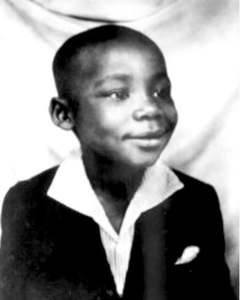
A71E0175-E6AE-4327-B283-A27F479B39FFIn 1930, Mandela’s father died from tuberculosis when Mandela was just 9 years old.  King Jongintaba Dalindyebo became Manela’s guardian.   Mandela lived at the Jongintaba homestead from age 9 to 16 and was raised with Jongintaba’s children. It was his first school teacher who gave him the Christian name, Nelson.  Hearing the elders’ stories of his ancestors’ valour during wars of resistance, he dreamed also of making his own contribution to the freedom struggle of his people.


====================

By 1930, there were 80 residential schools in Canada.  Indigenous  children were torn from their parents and placed in Residential Schools where they were “assimilated” – stripped of their culture and language.

====================

Mid-1900’s – Apartheid

Education is the most powerful weapon
which you can use to change the world.
– Nelson Mandela

56FEC61E-7551-4C4C-8148-BE8EAA191BBF

Mandela studied for a B.A. at the University College of Fort Hare but did not complete the degree as he was expelled for joining in a student protest.   On his return to the Great Place at Mqhekezweni, the King was furious.  In 1941, Mandela and his cousin ran away to Johannesburg.  Through acquaintances there,  he did his articles through a firm of attorneys – Witkin, Eidelman and Sidelsky.  He completed his B.A. through the University of South Africa and went back to Fort Hare for his graduation in 1943.

By this time, all of Africa, except Ethiopia, was colonized in a series of feudalized states in which white colonists controlled or owned most of the land and held all the power.

9F81657E-5668-416D-9A12-E7FA66AA186A


Mandela, increasingly politically involved from 1942, joined the African National Congress in 1944 when he helped to form the ANC Youth League (ANCYL).  He quickly rose up through the ranks of the ANC.

At the end of World War II, all of the African nations were given independence and most colonists were repatriated to their home countries.  It must have been a time of great optimism and hope for Africans.


But not so for South Africa.  In 1948, just three years after the war ended, the (former Afrikaner) National Party was elected, and Apartheid was enshrined in federal legislation and the country’s constitution.

4B806D96-4B24-4C39-BB49-0E5D174A9741

In 1950, the Population Registration Acclassified all South Africans into one of four racial groups:  “White,” “Black,” “Coloured” and “Indian.”  Places of residence were determined by racial classification.  From 1960–1983, 3.5 million Non-White South Africans were removed from their homes and forced into segregated neighbourhoods, in one of the largest mass evictions in modern history.

Most of these targeted removals were intended to restrict the black population to ten designated “tribal homelands”, also known as bantustans.  The government announced that relocated persons would lose their South African citizenship as they were absorbed into the bantustans.

Mandela continued to work his way up in the ANC through activism.  In 1952, he was chosen as the National Volunteer-in-Chief of the Defiance Campaign. He and 19 others were charged under the Suppression of Communism Act for their part in the campaign and sentenced to nine months of hard labour, suspended for two years.   He used this time to complete a 2-year law diploma which allowed him to practice law.

In 1955, the Strijdom government stacked the courts and the Senate, adding new positions and appointing pro-Nationalists.  In 1956, a joint sitting passed legislation that paved the way for what would ultimately leave whites as the sole group enfranchised with the right to vote.

On December 5, 1956, Mandela was arrested in a countrywide police swoop, which led to the 1956 “Treason Trial.” Men and women of all races found themselves in the dock in the marathon trial that only ended when the last 28 accused, including Mandela, were acquitted on 29 March 1961.

To be free is not merely
to cast off one’s chains,
but to live in a way that
respects and enhances
the freedom of others
.

– Nelson Mandela

1960’s  and 1970’s – Fighting Back, and Detention

Sharpeville
831E17F2-1FC1-4891-8457-11F45444D9CE

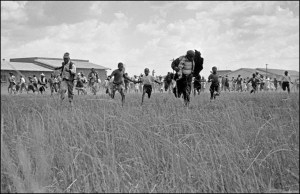
Sharpeville was the first major event to attract international attention.  On March 21, 1960, police killed 69 unarmed people in a protest in Sharpeville against the pass laws. This led to the country’s first state of emergency and the banning of the ANC. Mandela and his colleagues in the Treason Trial were among thousands detained during the state of emergency.  After a day of demonstrations against pass laws, a crowd of about 5,000 to 7,000 protesters went to the police station.

The South African Police opened fire on the crowd, killing 69 people and injuring 180 others.  There were 249 casualties in total, including 29 children. Many were shot in the back as they fled.  Photographer Ian Berry, who made this photo, initially thought the police were firing blanks.

In April 1960, the UN’s conservative stance on apartheid changed following the Sharpeville massacre, and the Security Council for the first time agreed on concerted action against the apartheid regime, demanding an end to racial separation and discrimination. On August 7, 1963, the United Nations Security Council passed Resolution 181, calling for a voluntary arms embargo against South Africa. From 1964 onwards, the US and the UK discontinued their arms trade with South Africa.

Apartheid policy was championed by the country’s prime minister, Hendrik Verwoerd, who was born and raised in Amsterdam.  He was responsible for the tightening of the laws and enforcement.  On April 9, 1960, a deranged white farmer shot Verwoerd in an assassination attempt that failed.  Six years later Verwoerd was stabbed to death in the parliamentary chamber by Demetrio Tsafendas, a Mozambique immigrant of mixed descent who said that the assassination was motivated by the great resentment he felt toward apartheid.

In May 1961, before the declaration of South Africa as a republic, an assembly representing the banned ANC called for negotiations between the members of the different ethnic groupings, threatening demonstrations and strikes during the inauguration of the republic if their calls were ignored.  When the government overlooked them, the strikers (among the main organisers was a 42-year-old, Nelson Mandela) carried out their threats.

The government countered swiftly by giving police the authority to arrest people for up to twelve days and detaining many strike leaders amid numerous cases of police brutality.  Defeated, the protesters called off their strike. The ANC then chose to launch an armed struggle through a newly formed military wing, Umkhonto we Sizwe (MK), which would perform acts of sabotage on tactical state structures. Its first sabotage plans were carried out on December 16, 1961, the anniversary of the Battle of Blood River.

In the face of massive mobilization of state security a massive national strike against Apartheid was called off early.

In June 1961, Mandela was asked to lead the armed struggle and helped to establish Umkhonto we Sizwe (Spear of the Nation), which launched on December 16, 1961 with a series of explosions.

Rivonia Trial

On January 11, 1962, using the adopted name David Motsamayi, Mandela secretly left South Africa. He travelled around Africa and visited England to gain support for the armed struggle. He received military training in Morocco and Ethiopia and returned to South Africa in July 1962.

On August 5, he was arrested in a police roadblock outside Howick while returning from KwaZulu-Natal, where he had briefed ANC President Chief Albert Luthuli about his trip.

Mandela was charged with leaving the country without a permit and inciting workers to strike. He was convicted and sentenced to five years’ imprisonment and, for the first time, spent time at Robben Island.

Within a month, police raided Liliesleaf, a secret hideout in Rivonia, Johannesburg, used by ANC and Communist Party activists, and several of his comrades were arrested.

On October 9, 1963, Mandela joined 10 others on trial for sabotage.

On April 20, 1964, while facing the death penalty, Mandela made a statement from the prisoner’s dock that inspired and motivated, and must have struck fear in some:

I have fought against white domination,
and I have fought against black domination.
I have cherished the ideal of a democratic and
free society in which all persons live together
in harmony and with equal opportunities.
It is an ideal which I hope to live for and to
achieve.  But if needs be, it is an ideal
for which I am prepared to die.

On June 11, 1964 Mandela and seven other accused, Walter Sisulu, Ahmed Kathrada, Govan Mbeki, Raymond Mhlaba, Denis Goldberg, Elias Motsoaledi and Andrew Mlangeni, were convicted and the next day were sentenced to life imprisonment. Goldberg was sent to Pretoria Prison because he was white, while the others went to Robben Island, where Mandela would spend the next 27 years of his life.

“A winner is a dreamer who never gives up.
– Nelson Mandela

I wondered what Mandela did in those 27 years and how it came to be that on his release he immediately became the key figure negotiating for an end to Apartheid with the South African government.  I think it is important to note that he was imprisoned with many of his ANC compatriots, and I imagine they found ways of meeting and continuing their work.   I found this article very illuminating about this difficult period:

https://www.npr.org/sections/parallels/2013/07/01/197674511/nelson-mandelas-prison-adventures

Soweto Uprising

In 1976, secondary students in Soweto took to the streets in the Soweto uprising to protest against the imposition of Afrikaans as the only language of instruction. On June 16, police opened fire on students protesting peacefully. According to official reports 23 people were killed, but the number of people who died is usually given as 176, with estimates of up to 700.  In the following years several student organizations were formed to protest against apartheid, and these organisations were central to urban school boycotts in 1980 and 1983 and rural boycotts in 1985 and 1986.

The UN Security Council also condemned the Soweto massacre in Resolution 392.   In 1977, the voluntary UN arms embargo became mandatory with the passing of Resolution 418.

1980’s – Progress

On March 31, 1982, Mandela was transferred to Pollsmoor Prison in Cape Town with Sisulu, Mhlaba and Mlangeni. Kathrada joined them in October. When he returned to the prison in November 1985 after prostate surgery, Mandela was held alone.  Justice Minister Kobie Coetsee visited him in hospital.  Later, Mandela initiated talks about an ultimate meeting between the apartheid government and the ANC.

In the early-1980s, Prime Minister Botha’s National Party government started to recognise the inevitability of the need to reform the apartheid system.  Early reforms were driven by a combination of internal violence, international condemnation, changes within the National Party’s constituency, and changing demographics – whites constituted only 16% of the total population, in comparison to 20% fifty years earlier.

The drive for change must have come out of a prevailing sense of dread in the white South African population.  Underlying Apartheid was always Africa’s geography itself, (so ironic considering the Dutch East Indies Company’s original success as mariner):  the white minority population living off the tip of Africa was terrified that the majority black population might rise up and run them all into the sea.

Concerned over the popularity of Mandela, Botha denounced him as an arch-Marxist committed to violent revolution, but to appease black opinion and nurture Mandela as a benevolent leader, the government transferred him from Robben Island to Pollsmoor Prison just outside Cape Town where prison life was more comfortable for him. The government allowed Mandela more visitors, including visits and interviews by foreigners, to let the world know that he was being treated well.

In January 1985, Botha stated that the government was willing to release Mandela on condition that Mandela pledge opposition to acts of violence to further political objectives. Mandela’s reply was read in public by his daughter Zinzi – his first words distributed publicly since his sentence to prison twenty-one years before. Mandela described violence as the responsibility of the apartheid regime and said that with democracy there would be no need for violence.

In 1986, the South African government began making its first serious overtures, and Mandela was secretly driven from the prison to the home of Kobie Coetsee, the justice minister, who would meet often with Mandela in the years that followed.

After much debate, by the late-1980s, the U.S., the U.K. and 23 other nations had passed laws placing trade sanctions on South Africa. A disinvestment from South Africa forbidding corporations from doing business with South African firms was also imposed.  The sports world also shunned South Africa and its athletes.

Between 1987 and 1993, the National Party entered into bilateral negotiations with the ANC for ending segregation and introducing majority rule.

On August 12, 1988, Nelson was taken to hospital where he was diagnosed with tuberculosis. After more than three months he was transferred to a house at Victor Verster Prison near Paarl where he spent his last 14 months of imprisonment. He was released from its gates nine days after the unbanning of the ANC. Throughout his imprisonment he had rejected at least three conditional offers of release.

1990’s – Freedom!

After 26 years in captivity, Nelson Mandela did not want to be set free straight away. Two days before his release, the world’s most famous political prisoner was taken to see President F.W. de Klerk in his Cape Town office. President de Klerk got a surprise.  “I told him he would be flown to Johannesburg and released there on February 11, 1990. Mr Mandela’s reaction was not at all as I had expected,” said De Klerk. “He said: ‘No, it is too soon, we need more time for preparation.’ That is when I realised that long hours of negotiation lay ahead with this man.”
FBAEB482-753C-4EB6-B4FA-41E9EBA00009

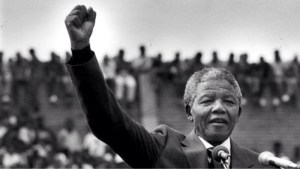
Just after 4pm, Mandela, then 71, walked free from Victor Verster prison, in Paarl, near Cape Town. Mandela held up his fist in an ANC salute. In an instant he switched from being a symbol of the oppressed to the global symbol of courage and freedom that he remains today.

“The cameras started clicking like a great herd of metallic beasts. I raised my right fist and there was a roar.  I had not been able to do that for 27 years and it gave me a surge of strength and joy.”

Four hours after leaving prison, Mandela arrived in Cape Town to address thousands of people gathered outside city hall. The impatient crowd had clashed with police and bullets had been fired. But Mandela did not bring a message of appeasement. “The factors which necessitated armed struggle still exist today,” he told the cheering onlookers.

Mandela immersed himself in official talks to end white minority rule and in 1991 was elected ANC President to replace his ailing friend, Oliver Tambo.

It always seems impossible until it’s done.
– Nelson Mandela

Apartheid was dismantled in a series of negotiations from 1990–91, culminating in a transitional period which resulted in the country’s 1994 general election, the first in South Africa held with universal suffrage.

In 1993 Mandela and President F.W. de Klerk jointly won the Nobel Peace Prize and on April 27, 1994, Mandela voted for the first time in his life.

866FD1E2-D7ED-448F-8E9B-B8668924F228

On May 10, 1994, Mandela was inaugurated as South Africa’s first democratically elected President.

Established in 1996, the Truth and Reconciliation Commission (TRC) was a court-like restorative justice body assembled in South Africa after the end of apartheid.  Witnesses who were identified as victims of gross human rights violations were invited to give statements about their experiences, and some were selected for public hearings. Perpetrators of violence could also give testimony and request amnesty from both civil and criminal prosecution.  The TRC, was seen by many as a crucial component of the transition to full and free democracy in South Africa.

====================

The Truth and Reconciliation Commission of Canada was active in Canada from 2008 to 2015, organized by the parties of the Indian Residential Schools Settlement Agreement. The purpose was documenting the history and lasting impacts of the Canadian Indian residential school system on Indigenous students and their families. The Commission concluded in December 2015 with the publication of a multi-volume report that concluded the school system amounted to cultural genocide.

========================

In 2005, Nelson Mandela spoke at the Live 8 concert in Johannesburg:

Sometimes it falls upon a generation to be great.
You be that great generation. Let your greatness
blossom. Of course the task will not be easy.
But not to do this would be a crime against
humanity, against which I ask all humanity
now to rise up.

In April 2007 his grandson, Mandla Mandela, was installed as head of the Mvezo Traditional Council at a ceremony at the Mvezo Great Place.

====================

On June 11, 2008 Prime Minister Stephen Harper stood in the House of Commons to offer, on behalf of the Government of Canada, an apology to Aboriginal peoples in Canada for the abuse, suffering, and generational and cultural dislocation that resulted from assimilative, government-sanctioned residential schools.

Conditions on most of the Canadian northern reserves remain poor, without access to clean drinking water and access to education mostly requiring children still to be separated from their parents to travel south.  The suicide rate is triple the rate of non-Indigenous.   The restorative justice work continues.

====================

Today in South Africa, problems remain, with a massive divide between wealthy whites and extreme poverty of most blacks.  At the end of Apartheid, land wasn’t transferred; blacks still don’t own land.  Some public housing projects have happened, but the homes were constructed within the Townships, those former bantustans and the land isn’t owned. Most still live in shacks.

The 2008 financial crisis led to massive job loss in the country’s biggest employment sector – mining.   Moody’s has South Africa’s credit rating at Baa3, the lowest investment-grade level, and has just slashed the country’s 2019 economic growth forecast for the second time.  If the agency downgrades South Africa again, it will kill foreign investment.  Tourism and other sectors are growing and there is a slowly growing black middle class, but there is still much economic work to do.


B78D196E-6DB8-4E5E-8BEE-D0BB4A14DE4B

On December 5, 2013, Rolihlahla “Nelson” Mandela, the first President of South Africa to be elected in a fully representative democratic election, as well as the country’s first black head of state, died at the age of 95 after a prolonged respiratory infection.  As he slipped off into sleep, I think he must have been satisfied that it was a life well-lived.  

Best,

Jan


Mother City


72356668-24D2-4B6D-A09C-2B87D21EC787

Cape Town is the founding city of South Africa and was established in 1652 as a refueling station for Dutch ships bound for the East (the Spice Route).    Dutch settlers were sent here to supply the ships of the Dutch East India Company.  The city is often referred to as the Mother of South Africa because it gave birth to the nation.

We visited “The Captain’s  Garden” on the site of the original garden where the first Dutch settlers grew their vegetables.  Now a botanical garden with an amazing array of trees, many of them came as gifts from countries around the world since it is located at the presidential palace.  A medicinal garden has been planted in tribute to  the first garden here, and a white rose HIV memorial garden has been added.    At the cafe, we had delicious red cappuccinos, made from rooibos tea.


On leaving the garden, we saw Archbishop Desmond Tutu’s home cathedral.  Next to it, a memorial to him was erected two years ago, known fondly as, “The Arch’s Arch.”


Fusion

E7FF8000-3BA6-4D83-B541-8A9D7C2BF79A

Spices were imported from Indonesia in bulk and brought huge profits due to the efforts and risks involved and seemingly insatiable demand.  The fusion of influences between Indonesia and the Netherlands is still present today in both the Netherlands and in Indonesia, especially in fusion of cuisines.  Similarly,  Indonesians came to Cape Town off Dutch ships as slaves, and their descendants are now known as “Cape Malay.” From their colourful enclaves, they have also influenced Cape Town’s cuisine, further discussed here

We visited the Cape Malay district and visited the Atlas Trading Store’s spice shop where fragrant bags of spices still roll in today.


We walked around the colourful neighbourhood, and were told the fashion industry often does photo shoots here.  We looked up, and…


Glamour

“CAPE Town is South Africa’s Los Angeles
to Johannesburg’s New York — the glitzy,
gorgeous, self-obsessed foil to its grittier,
more serious and more powerful big sister.
Which is not to say that it lacks a serious
side. Cape Town holds its own with
Johannesburg as a locus of South Africa’s
liberation struggle, and no other African
city combines heart-stopping beauty and
historical gravitas so effortlessly.”

                                                                             – New York Times

The legislative capital of South Africa, the city is known for its harbour, its natural setting in the Cape Floristic Region and for landmarks such as Table Mountain and Cape Point. It is one of the most multicultural cities in the world, reflecting its role as a major destination for immigrants and expatriates to South Africa.  The city was named the World Design Capital for 2014 and was named the best place in the world to visit by both The New York Times and The Daily Telegraph.  There are few better places to saunter aimlessly – and get a thrill out of it – than Cape Town. A fascinating blend of African, European and Malay influences, this wonderful city has emerged as the cosmopolitan heart of South Africa.

A Christo-sized Table Cloth

303D52E6-4319-4840-8602-0CA1EF9E228C

The name Table Mountain is self-evident, but the mountain itself is unsurpassed as a dramatic backdrop to the gorgeous city sprawling below.   Yesterday, we hoped to take a cable car to the top for spectacular views, but our tour description was “weather permitting” – the flat top of the mountain is often covered by orographic clouds, formed when a south-easterly wind is directed up the mountain’s slopes into colder air, where the moisture condenses to form the so-called “table cloth” of cloud. Legend attributes this phenomenon to a smoking contest between the Devil and a local pirate called Van Hunks.  When the table cloth is seen, it symbolizes the contest.

14941DBB-06D4-4D5C-992E-FD8CD9ABA1C9


We saw the table cloth for ourselves yesterday, but the forecast looked more promising more promising for today..

Instead, we went up Signal Hill for fabulous views of Robben Island and the city.


This morning was gloriously clear, and we made our way to the Table Mountain gondola to the peak for spectacular views of the city.  The wildflowers were spectacular, too.

The V & A

018321F6-A647-48B6-928F-4E94DC5BF4B9

DB2C881C-F773-4DB6-8798-ED29B7CB58A5


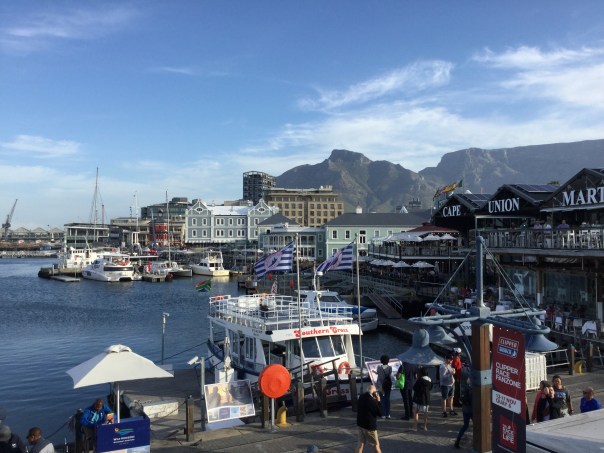
The V & A Waterfront refers not to Queen Victoria and her beloved Albert like the museum in London, but to Queen Victoria and her second son, Prince Alfred, who inaugurated the V&A Waterfront’s construction as a 16-year old midshipman in the Royal Navy in 1860. He returned 10 years later for the official opening of the completed works in July 1870. The area had electricity 10 years before the rest of Cape Town. 


The Waterfront has had a modern renewal and has become South Africa’s most-visited tourist destination.  We are staying in this  area comprised of a busy working harbour and with shops and restaurants, The Watershed, a beautiful and vibrant market for ceramics, textiles, furniture, fashion and jewellery. Also at the V & A are Africa’s premiere modern art gallery, the MOCAA, the South African Maritime Museum and an aquarium.  I am going shopping!


Another contribution from the New York Times, a blossoming love story from New York to Cape Town:

Capetonians have an expression that captures the atmosphere – “Moenie worry nie” – relax and enjoy.

Best,

Jan


PS. This is off-topic but I just discovered this incredible website for van Gogh lovers – “Unravel van Gogh” by the van Gogh Museum:    https://ontrafel.vangogh.nl/en