First, A Word About Zim
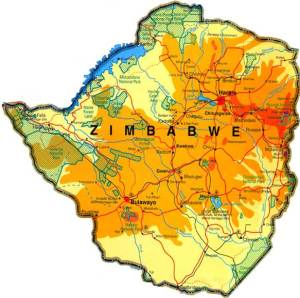
We were only in Zimbabwe for a night, but the situation there is volatile (not where we were). The border crossing was comical. The official kept me standing there for 15 minutes while he fiddled with a stuck stapler, frequently banging it on the counter, which of course accomplished nothing, until I just wanted to snatch it from his hands and fix it myself, but restraint was the order of the day.

After 30 years of corruption and dictatorship of Robert Mugabe, Zimbabwe may be in even worse straits than South Africa and Namibia.
 The current president, Emmerson Mnangagwa has struggled to fulfil promises of economic prosperity and greater political freedom. The health system has largely collapsed amid the worst economic crisis in more than a decade. Frustrations are running high as the economy crumbles. Inflation was last calculated at 300% by the International Monetary Fund in August, the world’s second highest after Venezuela. Electricity is only on for a few hours per day in the middle of the night, so that is when people have to work, and fresh water taps work for only a few hours on day a week.
In November in the capital of Harare, protesters were met with police who fired tear gas and water cannons and struck baton blows. Some Zimbabweans allege that repression is worse than under the late Robert Mugabe, who oversaw widespread rights abuses that led to international sanctions.
There may be some hope. The government is taking steps to turn the economy around, having just announced that the Reserve Bank of Zimbabwe plans to incrementally inject $1 billion into the economy over the next six months, stimulating demand and production in a measured manner while keeping money supply in check. We saw long lineups of people waiting at the banks.
The Geopolitical Monitor states that “implementing reforms – especially after decades of mismanagement – is a painful process and Zimbabweans are tired. But with political will tangible results are gradually being achieved. The country may be on the cusp of a better future, finally putting the years of isolation behind it. Perseverance and collaboration will help to ease the way.”
The Smoke that Thunders
Early this morning we left Botswana and crossed into Zimbabwe to witness the dreamy, amazing Victoria Falls. At the Falls, four countries merge: Zimbabwe, Zambia, Namibia and Botswana. Victoria Falls are on the Zambezi River. My research suggests the best viewing point for the falls is in Zimbabwe.
I heard recently from two independent sources that Victoria Falls was nothing but a dribble. I had the impression that was on the Zambia side, not the Zimbabwe side, and it appears that is correct. The Zambia visa is less expensive than the Zim visa, so people make the mistake of choosing to see them from Zambia.

That said, the water was at a three-year low and we were visiting at the driest time of year. The best time to see the falls begins in March. There were still falls, but half of the length of the sheet, which is what makes these falls so unique, was dry. This was more evident in the air. We took a helicopter spin to get the bigger picture.


On the ground, walking the 18 points from which to view the falls from Zimbabwe, they were more impressive.

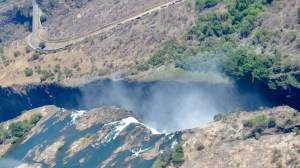
We could hear the roar of the falls and see the spray before we saw the actual falls themselves. This is one of the reasons why the local Makalolo tribe’s name for the falls, Mosi-oa-Tunya, “The Smoke That Thunders,” is so appropriate.

Scottish missionary and explorer David Livingstone (“Livingstone, I presume”) renamed them Victoria Falls when he became the first white man to see them, on November 16th 1855. Having heard stories of a spectacular waterfall, Livingstone paddled down the Zambezi in a dugout canoe and landed on a small island at the lip of the falls. In his diary, Livingstone wrote of the falls: “scenes so lovely must have been gazed upon by angels in their flight.”

Livingstone Island in the background.
We saw the Devil’s Cataract, a separate particularly heavy and dangerous flow.


The falls are twice the height of Niagara Falls and twice the width of its Horseshoe Falls.


The spray thrown up by the falls creates a special rainforest microclimate along the rims of the falls where there is 24/7, 365 days of annual rainfall, in what is otherwise a very dry area. We witnessed the spray and the full-on rain in the forest.


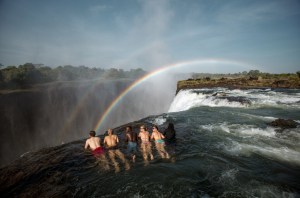
No, thank you. During the months of September to December, tourists enjoy ‘toying with danger’ on the edge of the waterfalls at the naturally formed Devil’s Swimming Pool. Several have died falling over the natural stone barrier and plunging down the falls.
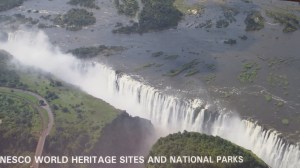
The Falls were beautiful, but I’d still like to see them like this, at full force.
I guess I’ll just have to come back.
Best,
Jan


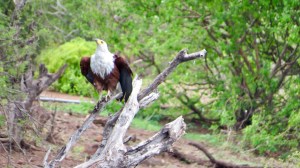


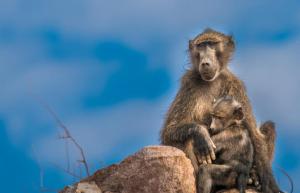
 Orphaned baboons whose mothers have disappeared or died are adopted and cared for by both mals and females,





 Yesterday, we crossed the border into Botswana, saying goodbye to beautiful Namibia and our amazing guide, Tuhefani (he was making the long drive all the way back to Windhoek in 2 days in order to vote in the upcoming election).


 The extent to which the British subordinated Botswanan interests to those of South Africa during this period became clear in 1950. In a case that caused political controversy in Britain and across the Empire, the British government banned Seretse Khama from the chieftainship of the Ngwato and exiled him for six years. This was done in favour of South Africa, who objected to Khama’s marriage to a British woman at a time when racial segregation was enforced in South Africa.
 In the 1950’s, the idea of an independent Botswana germinated.

 Although hippos lie close to each other in the water, they are actually solitary and do not seem to form social bonds except between mothers and daughters. Occasionally, they will bask alone on the shore, and if their skin cracks, they secrete an oily red moisturizer which gave rise to the myth that they sweat blood.


















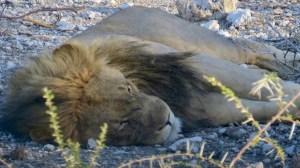
 There are so many misassumptions and fun facts about the beautiful, elegant lion. It is the female who is head of a pride of usually about 15 lions. The females do the hunting, the male defends the territory. Although the male eats first, the queen will have female “favourites” who get the most and best meat after the male, so the cubs of the pride may cosy up with the favourites over their own mother.

 Lions do not live in the jungle, they live on savannahs, like the land surrounding the Etosha pan..


 “A cheetah is a cross between a lion and a panthress, or a panther and a lioness.”
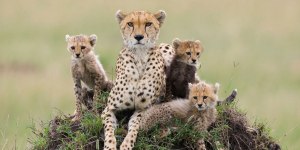 “It is said that if a Cheetah has a difficult pregnancy, any male cheetah that sees her will take care of her and share the fruits of his hunt. When she is ready to give birth, she secludes herself in a place that she has prepared and remains there until she teaches her young how to hunt.”


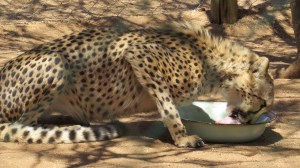
 We arrived at CCF just in time to see them fed.



 Carpe diem